
Level 1 Certificate in Engineering
Level 2 Certificate in Engineering
Level 3 Diploma in Engineering

COURSE AUDIENCE
Anyone interested in Engineering and/or technical trades.
These certificate and diploma courses are aimed at learners who:
- Wish for career progression within engineering
- Wish to build on the skills learnt from other technical qualifications
CITY AND GUILDS – A STORY OF HOPE
Watch this short video that highlights the successes of the City and Guilds partnership with Nations University’s School of Technology

These internationally recognized qualifications equip learners with the skills and knowledge needed to perform, supervise, and manage engineering operations effectively, from maintaining complex systems to ensuring the safe and efficient installation and commissioning of equipment.
Upon completion, graduates will be prepared to take on higher responsibilities within engineering and maintenance teams, pursue further education at advanced levels, or transition into specialized technical roles across sectors such as manufacturing, energy, oil and gas, construction, and utilities.
Level 1 Certificate in Engineering
The City & Guilds Certificate in Engineering Level 1 (2850-80) allows learners to learn, develop and practise the basic introductory skills required for employment and/or career progression in the engineering sector. The course allows progression onto the City and Guilds Level 2 Certificate in Engineering.
Level 2 Certificate in Engineering
The City & Guilds Certificate in Engineering Level 2 (2850-21) with a specialization in Mainteance Technology provides the foundation and knowledge to further develop the technical competence and professional confidence required in modern engineering environments preparing them for areas of higher study. The course allows progression onto the City and Guilds Level 3 Diploma in Engineering.
Level 3 Diploma in Engineering
The City & Guilds Diploma in Engineering Level 3 (2850-33) with a specialization in Maintenance, Installation and Commissioning is a comprehensive, hands-on programme designed to develop the technical competence and professional confidence required in modern engineering environments.
PROGRAMME STRUCTURE
To earn these qualifications, learners must successfully complete the following units:
Level 1 Certificate in Engineering
Unit 101: Working in Engineering (7 credits)
Unit 107: Carrying out Electrical Assembly (7 credits)
Unit 114: Carrying out Mechanical Maintenance (7 credits)
Upon the successful completion of all three units, learners will receive the Level 1 Certificate in Engineering and be ready to advance to the Level 2 Certificate.
Level 2 Certificate in Engineering
Unit 201: Working in Engineering (7 credits)
Unit 202: Principles of Engineering Technology (7 credits)
Unit 208: Principles of Maintenance Technology (7 credits)
Unit 209: Assembling & Maintaining Fluid Power Systems (7 credits)
Unit 223: Wiring & Testing Electrical Circuits (7 credits)
Upon the successful completion of all five units, learners will receive the Level 2 Certificate in Engineering with a specialization in Mainteance Systems.
Level 3 Diploma in Engineering
Unit 301: Engineering Health and Safety (9 credits)
Unit 302: Engineering Principles (9 credits)
Unit 306: Principles of Engineering Maintenance, Installation and Commissioning (9 credits)
Unit 321: Maintenance of Pneumatic Systems (9 credits)
Unit 328: Maintenance of Electrical Equipment and Systems (9 credits)
Unit 330: Organizing and Managing Engineering Operations (9 credits)
Upon the successful completion of all six units, learners will have the advanced skills required for employment and/or career progression in the engineering sector.
WHAT WILL I LEARN?
- Engineering Health & Safety Requirements
- Engineering Drawings and Specifications
- Requirements and Properties of Engineering Materials
- Engineering Mathematical Applications
- Engineering Science Applications
- Preparing for Maintenance Activities
- Dismantling/Assembly Techniques for Components/Systems
- Testing/Fault Finding Techniques
- Dismantle, Remove and Replace, Re-assemble and Test Systems to Conform to Specification
- Assembling Components and Preparing for Wiring and Testing of Electrical Circuits
- Carrying out the Wiring of Electrical Circuits
ENTRY REQUIREMENT
Levels 1 and 2 Certificate in Engineering
There are no formal entry requirements for candidates undertaking these qualifications.
Level 3 Diploma in Engineering
To gain entry onto the Level 3 Diploma the applicant must have one or more of the below requirements:
- Completed secondary education with passes in Math and English OR
- Completed the City and Guilds Level 2 Certificate in Engineering OR
- An equivalent qualification from a C-TVET centre.
COURSE DURATION
Classes run at nights and weekends for:
Level 1 Certificate in Engineering – 3 months
Level 2 Certificate in Engineering- 6 months
Level 3 Diploma in Engineering- 10 months
This course is managed by a Programme Manager who can be contacted to gain further information regarding the course details and the schedule of upcoming classes. Please feel free to contact:
Details
Mrs. Alana Gaspar
Phone: +592 22 65781 X1130
Email:
COST
Payment Plans Available for All Levels
Level 1 Certificate in Engineering – The course cost is normally GUY $350,000 but for a limited time only it is GUY $250,000
Level 2 Certificate in Engineering – The course cost is normally GUY $450,000 but for a limited time only it is GUY $350,000.
Level 3 Diploma in Engineering – The course cost is normally GUY $550,000 but for a limited time only it is GUY $450,000.

Successful learners will be awarded a Level 1 or 2 Certificate or Level 3 Diploma from City and Guilds. City & Guilds offers a range of products and services, mainly in vocational and technical education. One of their traditional strengths is the development of qualifications to ensure people learn skills that are work relevant and recognised by employers. A key part of these qualifications are assessments which are designed to measure the practical skills and knowledge of learners.
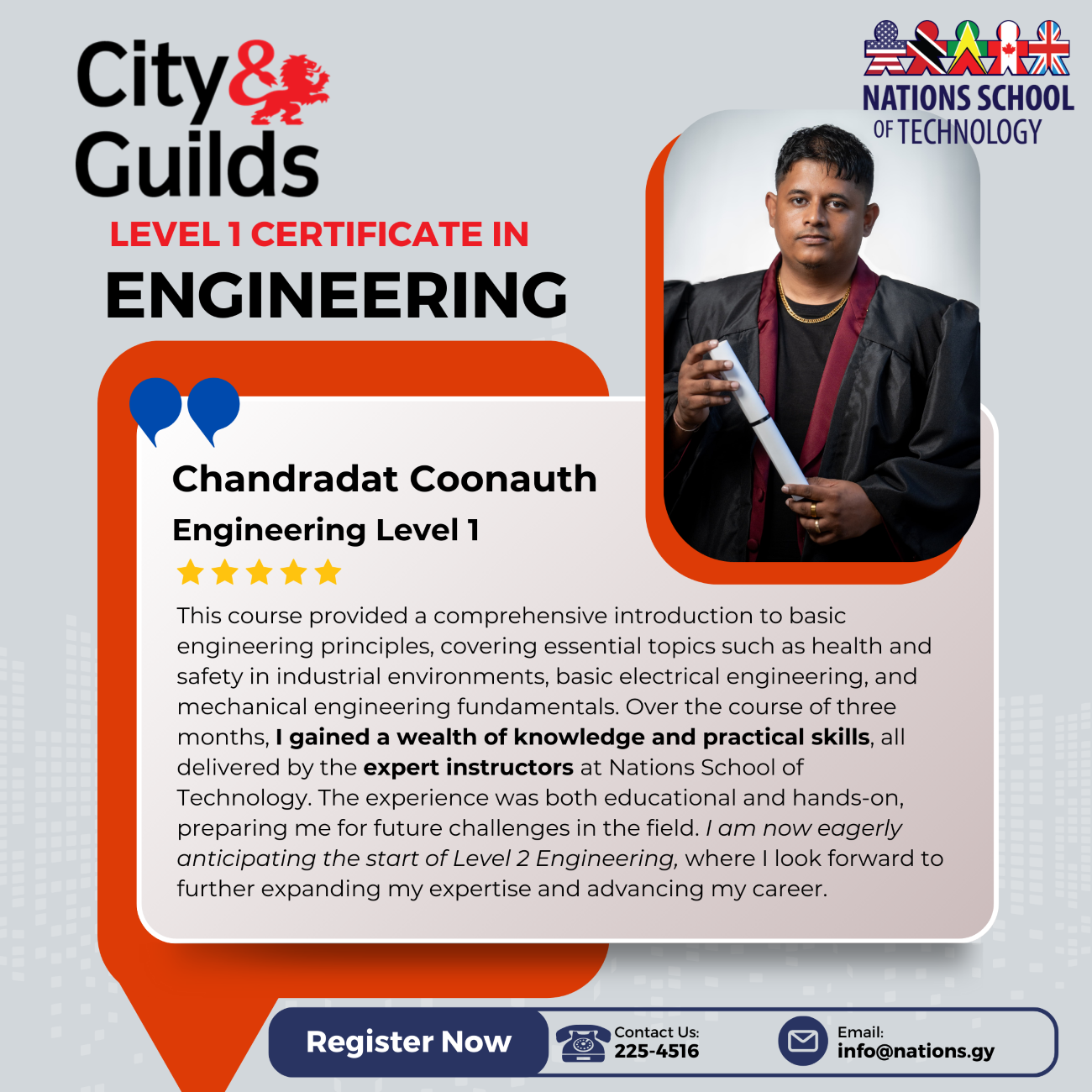
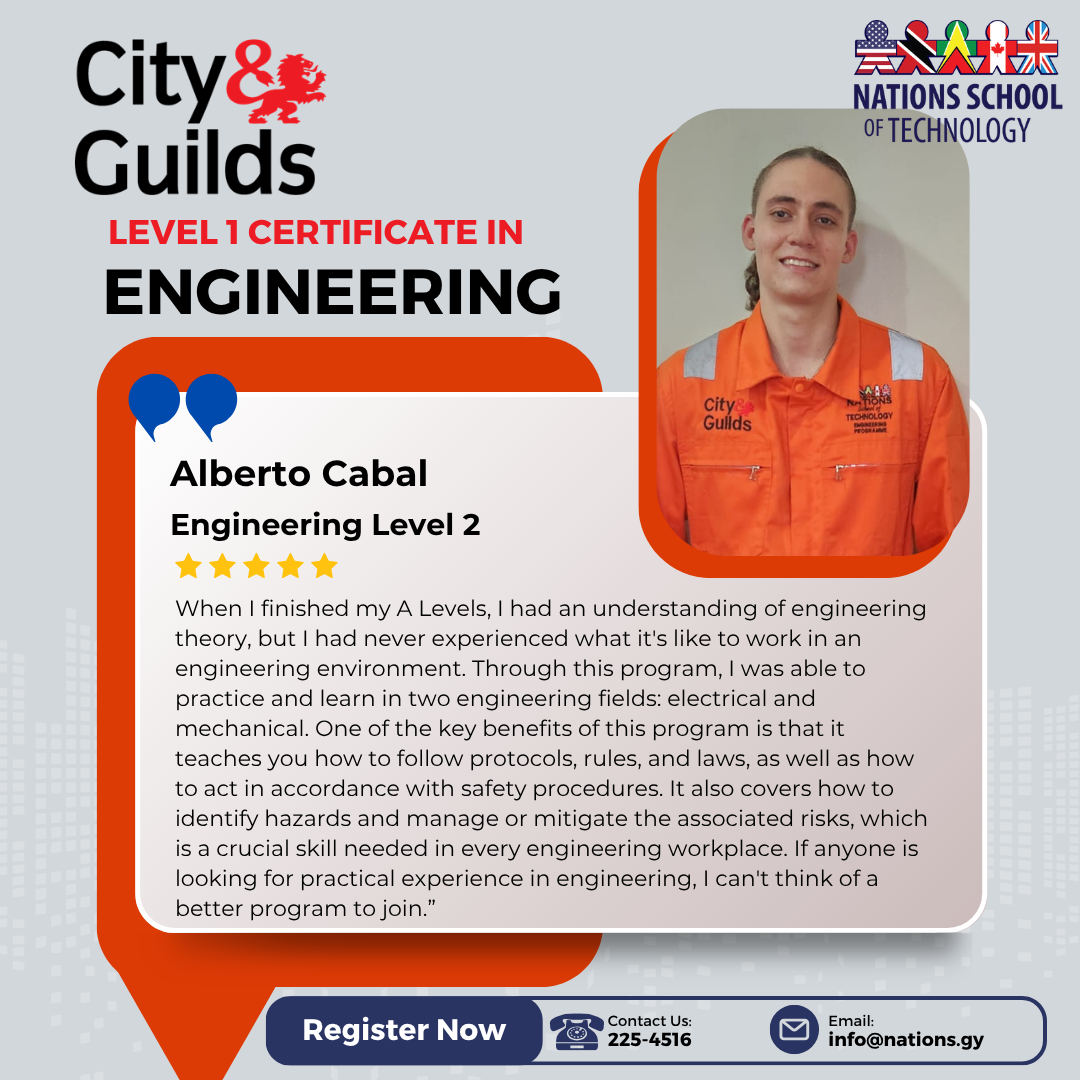
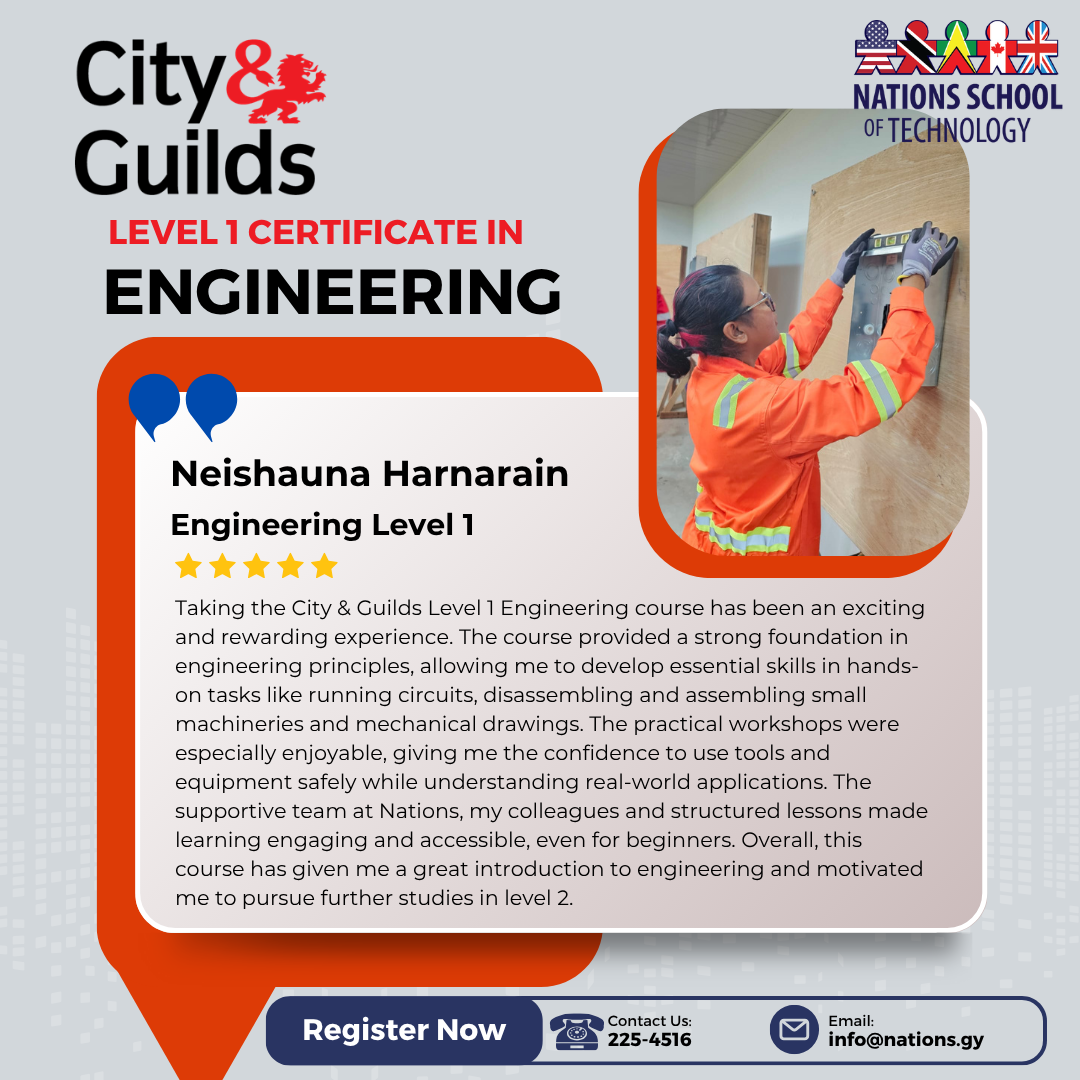
TESTIMONIAL
DOWNLOADABLE BROCHURE